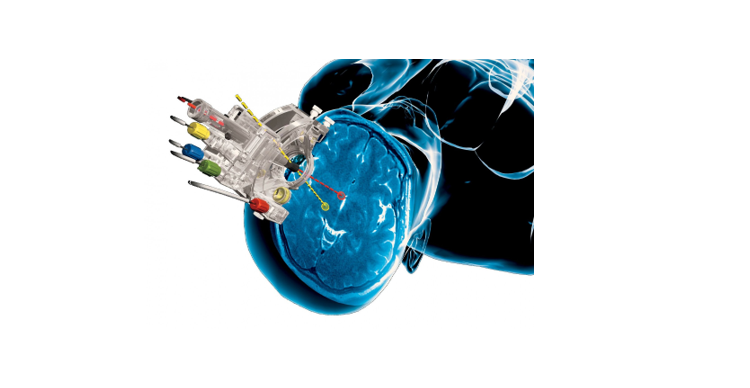
Deep Brain Stimulator
Deep brain stimulation (DBS) is a type of treatment for symptoms of some movement disorders, including dystonia, essential tremor, and Parkinson's disease (PD). DBS uses a surgically implanted, battery-operated device to send electrical signals to areas in the brain that control movement. The signals from DBS control (regulate) the nerve signals that cause movement disorder symptoms. It is a safe and effective treatment for many movement disorders that are not responding to medication.
More recently, DBS was also FDA-approved to treat epilepsy. The signals from DBS deliver stimulation to a part of the brain involved in the spread of some types of seizures.
A DBS system has three main components:
The electrode or lead is a thin, insulated wire inserted into the brain at different locations depending on what condition the DBS system will treat. Doctors insert the leads through small openings made in the skull.
The extension wire is an insulated wire placed under the skin and links the lead at the top of the person’s head with the location near the collar bone where it connects with the battery pack.
The battery pack, also called the implantable pulse generator (IPG), is the power source of the DBS system. Doctors usually implant the battery pack under the skin near the collarbone. In some cases, doctors position the battery back lower in the chest or under the skin over the abdomen.
The battery pack creates electrical pulses that travel through the extension wire and to the lead in the brain. These pulses change the brain's electrical activity at a target site to regulate the signals sent to muscles and reduce movement disorder symptoms. After DBS surgery, a doctor programs the signals sent by the DBS system. DBS programming fine tunes the system to be most effective for the person. Finding the right DBS setting can be a complex process and may take multiple visits with a neurologist.
DBS was first approved by the U.S. Food and Drug Administration (FDA) in 1997. NINDS-supported research on brain circuitry was critical to the development of DBS. Today, NINDS-funded researchers are continuing to study and improve DBS treatments.
In one current study at the NINDS clinical center, people with DBS for Parkinson’s, dystonia, or essential tremor receive on-going care to monitor the effects of DBS. Researchers periodically examine people in the study after DBS surgery and adjust their DBS programming. The study tests movement, thinking, and memory in DBS recipients. Several other clinical studies track people after DBS surgery to find ways that the DBS can be more effective and reduce side effects or complications.
How does deep brain stimulation treat disorders?
DBS works by regulating signals that cause movement symptoms. DBS can target different areas of the brain, depending on what condition it is used to treat. Current DBS methods typically target one of the following areas of the brain:
Globus pallidus internus, which helps regulate intended movement (targeted in PD and dystonia treatment)
Subthalamic nucleus, which helps direct how the body prepares to move (targeted in PD and dystonia treatment)
Thalamus, which relays and integrates sensory and movement information (targeted in PD and essential tremor treatment)
Before DBS surgery, a neurosurgeon uses noninvasive imaging—either MRI (magnetic resonance imaging) or CT (computed tomography) scans—to find the best place in the brain to implant the DBS leads. During DBS surgery, many surgeons insert a small wire to monitor the activity of nerve cells and to identify the exact area of the brain that the DBS system will stimulate.