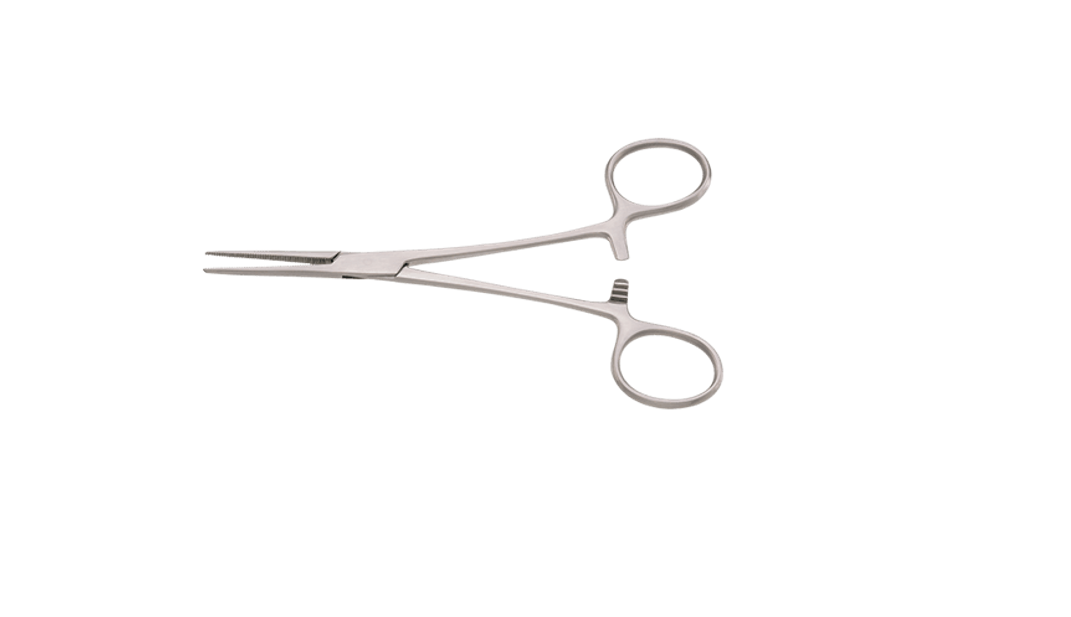
Surgical Forceps
Medical forceps, as a key medical device in surgery, undertake the important tasks of holding, pulling, separating, and cutting human tissues [1,2,3,4]. However, in actual surgical operations, there are involuntary movements of the surgeon’s hand, including physiological tremors, jerks, and other minute movements, which inevitably affect the precision of surgical operations [5,6,7]. In addition, the relationship between the pressure at the clamping site of medical force and operating force shows complex nonlinear characteristics and lacks a force feedback and force control module, which makes it difficult for doctors to accurately perceive the actual magnitude of the clamping force and, in turn, affects the precision of the operation of the instruments. This may lead to biomechanical compatibility and safety problems between medical force and human tissues, resulting in serious medical errors [8,9].
In order to improve the safety of surgical procedures, researchers have proposed various improvements for hand-held surgical instruments [10,11,12,13,14]. E Burdet et al. [15] designed novel haptic tweezers with an integrated six-degree-of-freedom DELTA haptic interface, which has been used for virtual reality-based microvascular surgery training. Tianci Zhang et al. [16] developed a hand-held active tremor compensation instrument to improve tip positioning accuracy in microsurgery, and the experimental results showed that for the hand-held test, the average RMS (effective value) reduction ratio was 41.0%. Christopher J. Payne et al. [17] proposed a novel microsurgical forceps with amplified force feedback and used an actuator to apply a mechanically ungrounded device to the operator’s fingertip by an amplified force. Toshihiro Kawase et al. [18] investigated the processing of a force sensor-based input device for hand-held robotic tweezers (UIA) to reduce unintended inputs in the tweezers’ tip direction operation due to gripper manipulation. Canaan Ng et al. [19] provided a one-DOF force feedback device for surgical tweezers by adding a Hall effect sensor directly to the surgical tweezers and a voice coil actuator to provide one-DOF force feedback. Latt et al. [20] developed a hand-held device with force control to maintain stable probe–tissue contact and used it for porcine rectal imaging in anal endoscopic microsurgery. Yao et al. [21] developed a haptic amplification hand-held robot to aid in lesion detection in arthroscopic interventions. A magnetic actuator was used to amplify the signal to provide vibrotactile feedback to the surgeon. Feng Ju et al. [22] investigated a miniature haptic sensor with a diameter of less than 8 mm suitable for catheterized robotic tissue hardness touching, in order to provide haptic feedback to the surgeon during surgery. Jong-Seok Oh et al. [23] proposed a novel four-DOF haptic master hand; by employing a controllable current-variable fluid, the master hand generated a four-DOF repulsive force, which had the advantages of a simple mechanism and the ability to control continuous force. Compared with medical surgical robots with other operating modes, the hand-held robot has a compact structure, low manufacturing cost, and easy integration into the normal surgical workflow [24,25,26], while retaining the sense of interaction between the surgeon’s surgical operation and the operation method of traditional surgical instruments. This greatly reduces the learning cost of the surgeon and brings a higher degree of flexibility and convenience to surgical operations [27,28].